
Zhao Chen, Assistant Research Fellow at the Institute of Philosophy of Our Academy, Published an Academic Article in the Authoritative Journal,Journal of Tsinghua University (Philosophy and Social Sciences)
 打印
 收藏
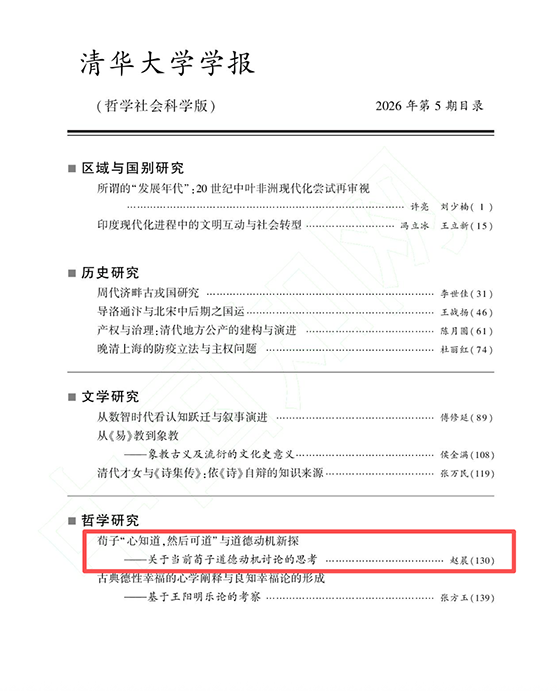
Zhao Chen, Assistant Research Fellow at the Institute of Philosophy of our Academy, published an academic article titled "Xunzi's 'When the Mind Knows the Way, Then It Can Endorse the Way' and a New Exploration of Moral Motivation——Reflections on the Current Discussion of Xunzi's Moral Motivation" in the authoritative journal,Journal of Tsinghua University (Philosophy and Social Sciences), Issue 5, 2026.

Zhao Chen
Assistant Research Fellow, Institute of Philosophy
Beijing Academy of Social Sciences
Xunzi's moral philosophy has long been a focal point of scholarly attention. The traditional interpretation holds that Xunzi advocated the Human Nature is Evil and that the heart-mind possessed only rational cognitive capacity. Consequently, his moral philosophy was confronted with the problem of insufficient moral motivation. In fact, within Xunzi's philosophical system, a person could, on the basis of knowing the Way, internalized the Dao of ritual and propriety through transforming one's nature and initiating deliberate effort, thereby forming a stable moral character which in turn provided the impetus for moral conduct. From an internal perspective, the heart-mind was endowed with the rational capacity of rightness/discernment. It was not merely a cognitive mind but a moral and deliberative mind, possessing an inherent demand for proper order as well as the capacities for moral cognition, moral judgment, and moral creativity. It was precisely because of this rational capacity of the heart-mind that the earliest sages developed a profound aversion to the social disorder and widespread destitution caused by the indulgence of emotional desires. This aversion to harm and aversion to disorder became crucial motivational forces driving them to take the long view and consider the future and culminating in the creation of the Dao of ritual and propriety. Knowing the Way was the concrete cognition of the Dao of ritual and propriety, while rightness/discernment served as the fundamental guarantee for the heart-mind's value judgments. Only when moral knowledge was combined with the internal agency could one generate endorsing the Way, the approval and inner desire for the Dao of ritual and propriety. As a moral motivation, endorsing the Way further impelled the agent to practice the Way, thus completing the transition from moral knowledge to moral action.