
Assistant Researcher Xin Chongchong and Co-authors from Our Academy’s Institute of Economics Published an Academic Article in the Authoritative Journal Economic Perspectives
 打印
打印 收藏
收藏 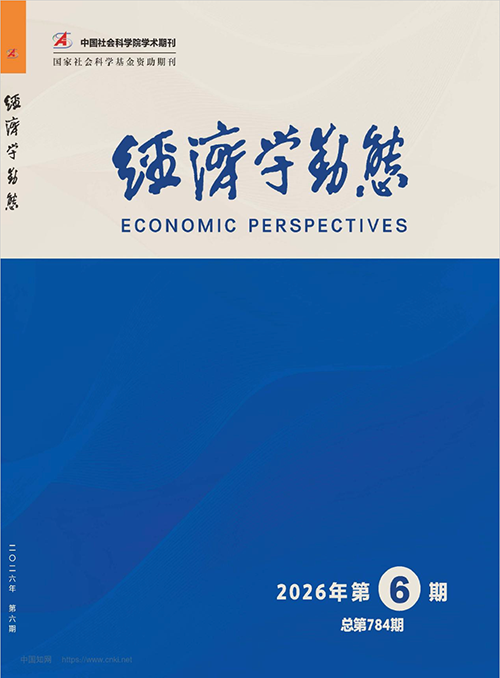
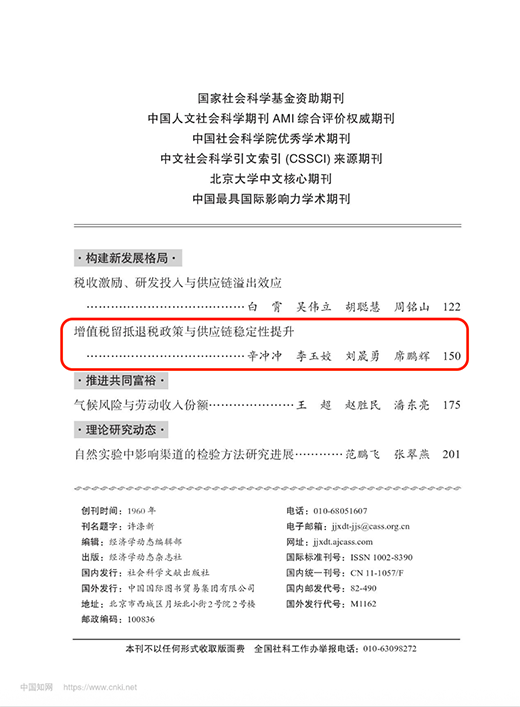
Xin Chongchong, an Assistant Researcher at Our Academy’s Institute of Economics and the First Author, together with Co-authors, published an academic article titled “VAT Credit Refund Policy and the Enhancement of Supply Chain Stability” in Issue 6, 2026 of the Authoritative Journal Economic Perspectives.

Xin Chongchong
Assistant Researcher, Institute of Economics
Beijing Academy of Social Sciences
Article Overview
Ι. Research Background and Significance
At present, global industrial competition has entered a “Chain Era” centered on industrial and supply chains. Supply chain stability affects not only the continued operation of individual enterprises, but also impacts the security of the industrial system and the smooth flow of macroeconomic cycles. The Report to the 20th National Congress of the Communist Party of China called for efforts to “enhance the resilience and security level of industrial and supply chains,” while the Third Plenary Session of the 20th Central Committee of the Communist Party of China further called for “improving the systems for enhancing the resilience and security level of industrial and supply chains.” This indicates that supply chain stability is no longer merely an issue of enterprise management, but an important matter related to the development of a modern industrial system and high-quality economic growth. In practice, China’s industrial and supply chains are generally resilient, but they continue to face pressures arising from constraints in key core technologies, fluctuations in external demand, rising costs, and vulnerabilities in certain parts of the chain. As fundamental nodes in supply chain networks, enterprises influence the stability of relationships with upstream and downstream partners through their cash flow, ability to fulfill contractual obligations, contractual relationships, and transaction costs. If corporate funds remain tied up for extended periods, procurement, production, payment, and delivery may be affected, thereby increasing the risk of supply chain disruption. Therefore, improving enterprises’ financial conditions through policy instruments and strengthening the stability of cooperation between enterprises and upstream and downstream partners has become an important issue in enhancing the security level of industrial and supply chains.
The VAT (value-added tax) credit refund policy has been an important component of China’s structural tax and fee reduction measures and VAT system reform in recent years. At its core, the policy refunds enterprises for input VAT that has not yet been fully credited, thereby reducing the amount of corporate funds tied up in taxation and improving cash flow. Since 2018, China has gradually expanded pilot programs for VAT credit refunds. From a theoretical perspective, the VAT credit refund policy has clear transmission effects along the supply chain. Because VAT applies across multiple stages of enterprise procurement, production, and sales, the refund of excess input VAT affects not only the cash flow of individual enterprises but may also be transmitted throughout the supply chain network through transactions with suppliers and customers. Refunds can help enterprises pay suppliers on time, maintain stable production arrangements and customer deliveries, reduce the risk of default, and strengthen trust between upstream and downstream enterprises. Therefore, the VAT credit refund policy may not only reduce enterprises’ tax burden and improve corporate performance, but also generate positive spillover effects in stabilizing supply chain relationships and strengthening industrial and supply chain resilience.
Existing research has focused extensively on the effects of the VAT credit refund policy on corporate investment, firm value, total factor productivity, digital transformation, and green innovation. However, there remains a lack of systematic evidence on whether this policy can improve supply chain stability and through which channels such effects occur. Against this backdrop, the article treats the VAT credit refund policy as a quasi-natural experiment and uses data from Chinese A-share listed companies from 2014 to 2022 to empirically examine the impact of tax incentives on corporate supply chain stability. It further analyzes three transmission mechanisms: financing constraints, contract stability, and transaction costs. The study helps reassess the economic effects of the VAT credit refund policy from a supply chain perspective and provides empirical evidence for improving tax policy and strengthening the resilience and security level of industrial and supply chains.
Ⅱ. Major Findings
The article first examines the overall impact of the VAT credit refund policy on corporate supply chain stability. The study finds that the policy significantly improves supply chain stability. Specifically, it improves both supplier stability and customer stability, indicating that the VAT credit refund policy can simultaneously strengthen the cooperative relationships between enterprises and their upstream suppliers and downstream customers. To ensure the reliability of the findings, the article conducts a series of robustness tests. The results remain valid after parallel trends tests, placebo tests, excluding the interference of contemporaneous policies, and applying methods including double machine learning, stacked difference-in-differences, propensity score matching, excluding observations from the year of policy implementation, replacing the dependent variable, using a balanced panel, and adjusting the time dimension of control variables. These tests demonstrate that the finding that the VAT credit refund policy improves supply chain stability is highly robust.
At the mechanism level, the article finds that the VAT credit refund policy affects corporate supply chain stability primarily through three channels. First, the policy helps alleviate corporate financing constraints. By refunding excess input VAT that would otherwise remain tied up, it directly improves corporate cash flow, strengthens internal financing capabilities, and reduces reliance on external financing. Once financing constraints are erased, enterprises can pay suppliers more promptly and arrange procurement, production, and delivery more reliably, thereby reducing the risk of supply chain disruptions. Second, the VAT credit refund policy enhances contractual stability. Refund funds strengthen enterprises’ ability to fulfill contractual obligations and make payments, helping to improve the matching of supply and demand, increase inventory management efficiency, and expand commercial credit. As a result, trust between enterprises and their suppliers and customers is strengthened, making long-term cooperative relationships more stable. Third, the policy reduces corporate transaction costs. On the one hand, it improves the predictability of future cash flows and reduces institutional transaction costs. On the other hand, improved cash flow lowers non-institutional transaction costs associated with emergency procurement, temporary changes of suppliers, remedies for contractual default, and rebuilding business relationships. As transaction costs decline, enterprises are better able to maintain stable relationships with upstream and downstream partners, while the overall operating efficiency of the supply chain also improves.
The article further examines the economic consequences associated with the improvement supply chain stability brought about by the VAT credit refund policy. The results show that the policy not only improves supply chain stability, but also further enhances supply chain resilience, enterprises’ sustainable development capacity, and total factor productivity. This indicates that supply chain stability is not limited to cooperative relationships, but can also translate into stronger risk resilience, greater long-term development capacity, and higher production efficiency. Heterogeneity analysis shows that the effects of the VAT credit refund policy vary across different types of enterprises. The policy effect is more pronounced among non-state-owned enterprises, technology-based enterprises, enterprises whose senior executives have financial backgrounds, and enterprises with lower perceived economic policy uncertainty.
Overall, the study shows that the VAT credit refund policy is not only a preferential tax policy that helps ease financial pressure on enterprises, but also an institutional arrangement that can improve supply chain stability and strengthen the resilience of the industrial and supply chains. By improving corporate cash flow, the policy further affects key areas such as financing, contractual relationships, and transaction costs, ultimately helping enterprises establish more stable cooperative relationships with their upstream and downstream partners.
Ⅲ. Policy Implications
First, the reform of the VAT credit refund policy should continue to be deepened so that it can play a greater role in stabilizing supply chains. The policy can effectively improve corporate cash flow and generate positive spillover effects through supply chain networks. Going forward, the design of the refund policy should be further improved on the basis of experience gained from existing policy implementation. In light of the actual operation of industrial and supply chains, the scope of policy coverage can be appropriately expanded to include more enterprises that occupy key positions in the chain, face significant pressure from tied-up funds, and have a strong influence on supply chain performance. At the same time, the efficiency of policy implementation should be further improved by optimizing refund procedure, reducing the time and administrative costs associated with applications and waiting periods, and enabling refund funds to return more quickly to enterprises’ business operations.
Second, greater emphasis should be placed on improving the transmission of policy effects and strengthen the ability of enterprise supply chains to withstand risks. The study finds that financing constraints, contract stability, and transaction costs are important channels through which the VAT credit refund policy affects supply chain stability. Therefore, policy implementation should not stop at simply ensuring that “refunds are being credited to enterprises’ accounts.” Attention should also be given to how refund funds can be translated into stronger operational capacity and greater supply chain coordination capability. Financial institutions can use refund records, tax credit information, and supply chain transaction data to improve enterprise credit assessments and strengthen credit support for small and medium-sized enterprises and private enterprises. Tax authorities, industry and information technology departments, and commerce departments can also enhance data coordination to identify weak links and key enterprises in supply chains, and promote stronger coordination among tax refund policies, financial support policies, and industrial policies.
Third, enterprises should improve the efficiency with which they refund funds and turn policy benefits into stronger long-term development capacity. After receiving tax refunds, enterprises should not use the funds solely to supplement short-term liquidity, but should also integrate their use with supply chain management, technological upgrading, inventory optimization, customer relationship management, and supplier coordination. For enterprises with relatively weak supplier relationships, high customer concentration, or greater exposure to external shocks, priority should be given to using refund funds to improve payment arrangements, stabilize procurement channels, and strengthen delivery capacity. For technology-based enterprises and manufacturing enterprises, a greater portion of refund funds should be directed toward research and development, equipment upgrading, and production process optimization, thereby creating a virtuous cycle between supply chain stability and productivity improvement.
Fourth, a more dynamic and precise tax policy evaluation mechanism should be established. Supply chain operations are complex and dynamic, and enterprises across different industries, of different sizes, and under different forms of ownership do not respond to the VAT credit refund policy in the same way. Going forward, continuous monitoring of policy effects should be strengthened, with particular attention to evaluating the actual impact of the refund policy across different types of enterprises, different stages of industrial and chain supply, and different regions.
Fifth, the VAT credit refund policy should be incorporated into the broader institutional framework for enhancing the resilience and security of industrial and supply chains and advanced in a coordinated manner. Going forward, greater use should be made of tax big data, monitoring of supply chain operations should be strengthened, and policy support should be extended from individual enterprises to entire supply chain networks. This helps identify key nodes and risk points in industrial and supply chains more effectively and provide support for further improving the institutional framework for enhancing their resilience and security.