
Associate Researcher Wang Peng of Our Academy’s Institute of Management Publishes the Book-A New Paradigm for High-Quality Urban Development in the Context of Digital and Intelligent Transformation: Smart Beijing Empowering the Development of the “Two Zones”
 打印
打印 收藏
收藏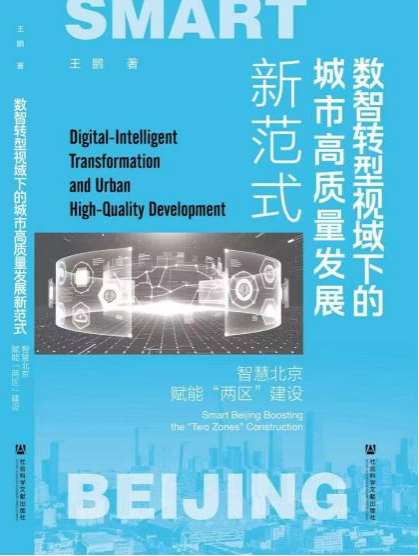
A New Paradigm for High-Quality Urban Development in the Context of Digital and Intelligent Transformation: Smart Beijing Empowering the Development of the “Two Zones”
By Wang Peng
Social Sciences Academic Press
About the Author

Wang Peng holds a Ph.D. in Public Administration and is an Associate Researcher. He received his bachelor’s and master’s degrees from Renmin University of China and his doctorate from the Party School of the Central Committee of the Communist Party of China (National Academy of Governance). He has undertaken a number of major research projects, including Youth Project under the National Social Science Fund of China (NSSFC), NSSFC Post-Funded Project, the Beijing Social Science Fund Young Academic Leader Project (Key Project), and Major Project of Beijing Social Science Think Tank. He has published several academic monographs and numerous articles in core journals, as well as multiple theoretical articles in the “Three Major Newspapers and One Core Journal,” namely People’s Daily, Guangming Daily, Economic Daily and Qiushi. His research has received written comments from Party and State leaders and Beijing municipal leaders on multiple occasions. In recent years, he has also participated extensively in work related to data factor market reform undertaken by central government ministries and agencies, including the State-owned Assets Supervision and Administration Commission of the State Council, the National Development and Reform Commission, the Cyberspace Administration of China, the Ministry of Industry and Information Technology, and the National Data Administration. Research Fields: Digital Government, Digital Economy, Data Factors, and Artificial Intelligence.
Book Overview
The book systematically explores new pathways for high-quality urban development in the context of digital and intelligent transformation. Taking Beijing as its primary focus, it provides an in-depth analysis of the integrated development of “Smart Beijing” and the Integrated National Demonstration Zone for Opening up the Services Sector and the China (Beijing) Pilot Free Trade Zone, collectively known as the “Two Zones”.
The book develops a systematic research framework comprising “Theoretical Framework—Practical Landscape—International Experience—Integration Pathways—Policy Recommendations,” comprehensively covering the core concepts and policy development of digital and intelligent transformation, smart cities, and the “Two Zones.” The book not only provides an in-depth interpretation of the strategic plans of the central government and the Beijing municipal government for citywide digital and intelligent transformation and the development of a global benchmark city for the digital economy, but also systematically reviews the practical achievements and progress of “Smart Beijing” in areas including industrial transformation, urban governance, factor allocation, digital infrastructure, and public services. Through case studies of leading international smart cities, including London, New York, Singapore, Tokyo, and Barcelona, this book distills relevant experience and lessons. Grounded in the realities of China’s digital economy development, it further examines the needs and theoretical pathways for integrating Smart Beijing with the development of the “Two Zones” across multiple areas, including government services, healthcare, transportation, finance, industry, and communities. By combining analysis of practical conditions with a systematic review of relevant policies, the book closely integrates theory and practice and provides an important reference for understanding trends in urban digital and intelligent transformation and advancing high-quality regional development.
With its forward-looking perspective, in-depth analysis, and wealth of case studies, this book serves as an important reference for the era of the digital and intelligent economy. It not only provides policymakers, urban managers, and industry professionals with professional insights into the development of smart cities and free trade zones, but also practical guidance for data-driven innovation and the integration of the digital and real economies. By effectively combining domestic practice with an international perspective, and institutional innovation with technological innovations, the book creates a strong link between theoretical guidance and practical application. It serves as a valuable tool for advancing citywide digital and intelligent transformation and developing a global benchmark city for the digital economy. Decision-makers, researchers, and others interested in urban development can all draw valuable insights from this book to better understand the dynamics of urban development amid the ongoing wave of digital and intelligent transformation.