
New Book “Image Consciousness and Visual Rhetoric: The Path and Vision of Chinese Cultural Values Transmission” Published
 打印
打印 收藏
收藏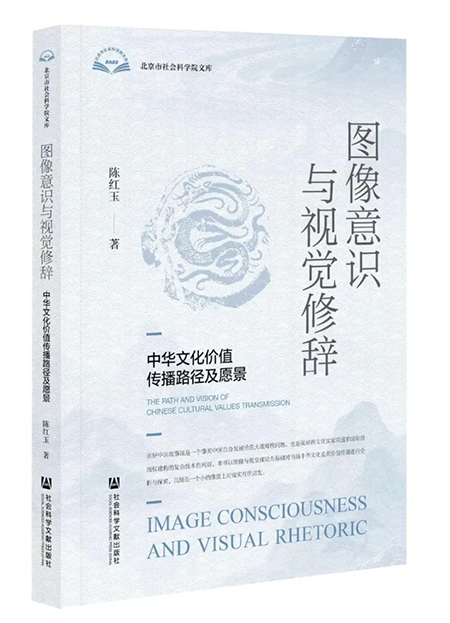
Image Consciousness and Visual Rhetoric: The Path and Vision of Chinese Cultural Values Transmission
By Chen Hongyu
Social Sciences Academic Press

Chen Hongyu, Researcher of the Institute of Culture, Beijing Academy of Social Sciences
Introduction
Telling China’s story effectively is not only a critical issue for China’s own development but also a complex challenge involving cross-cultural communication and the establishment of international discourse dominance. Drawing on image and visual theory, this book analyzes and explores the transmission of Chinese culture and its values, with the aim of offering insights for the present.
Against the backdrop of a new round of technological revolution, intelligent communication—represented by big data, artificial intelligence, and algorithmic recommendations—is profoundly reshaping the global landscape of information transmission and the circulation of cultural products. Based on this new environment for cultural communication, this book proposes the concept of “visual consciousness” and its corresponding communication paradigm in the transmission of Chinese culture and its values. It attempts to situate the role of visual media in the agenda-setting of cross-cultural communication within a broader context for evaluation and understanding, highlighting the significance and functions of visual imagery, as well as the intrinsic connection between visual media and cultural communication. Telling China’s story well is both the outcome and the conclusion; visual languages such as symbols, images, and videos are indispensable methods, means, and paths for effectively conveying China’s narrative. In a consumer society, the expansion of visual imagery proceeds in tandem with the growth of modern media; images are made accessible to the public through media networks, yet their true meaning remains obscured. In the process of cross-cultural communication, the transmission of images, visuality, and their cultural values is, in essence, a global power struggle in the realm of space. Research on the transmission and export of Chinese cultural values represents a deeper exploration of value transmission grounded in this real-world “visual turn.” Images are not merely entities existing at the level of simple symbolic meaning. This book seeks to view images as a medium that carries information, while visual rhetoric is a method of conveying and exchanging meaning through visual media. It involves the interaction between visual media and semantic contexts, as well as how this interaction influences the production and interpretation of meaning in images.
In terms of cultural value transmission, images and visual elements possess communication advantages unmatched by other media. This book argues that visual media serve as a crucial fulcrum for cross-cultural communication and further proposes the “STVP” model—a more adaptable framework for the visual dissemination of cultural values. Based on the principle of interculturality, it emphasizes the distinctive quality of “imagery sedimentation” in value transmission. Focusing on the transmission of Chinese cultural values, this book advocates starting from the core of national culture to reshape cultural imagery and adopt immersive communication strategies, thereby highlighting the “unconscious” sedimentation of cultural values through visual means during the communication process. The cultural values transmission remains a vast and complex subject; even though this book limits its scope to the field of imagery and visual communication, there are still many branches worthy of in-depth study. The publication of this book offers only a small glimpse into this field, and it is hoped that it will serve as a catalyst for further research.