
Monograph "Strategies of Digital Government Construction from the Perspective of Public Value" Published
 打印
打印 收藏
收藏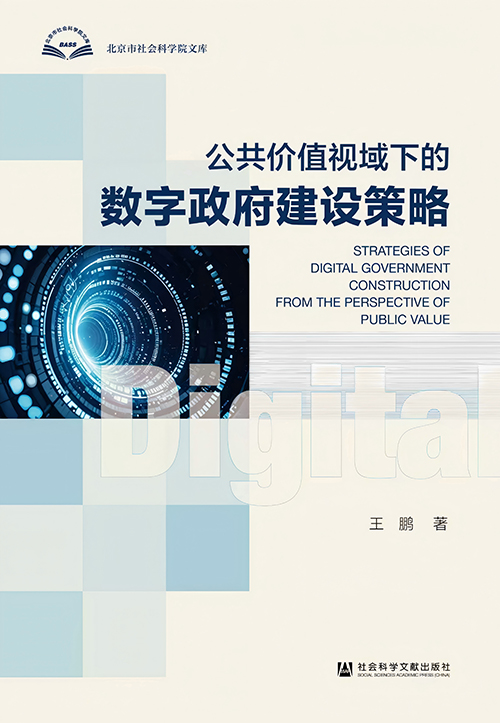
The monograph Strategies of Digital Government Construction from the Perspective of Public Value, authored by Wang Peng, Associate Research Fellow of the Institute of Management Studies of the Beijing Academy of Social Sciences (BASS), has recently been published by Social Sciences Academic Press(CHINA).
About the Author

Wang Peng holds a Ph.D. in Public Administration. He completed his undergraduate and master's studies at Renmin University of China (RUC) and obtained his doctorate from the Party School of the CPC Central Committee (National Academy of Governance). He has undertaken a number of key research projects, including the Youth Project and Post-funded Project of the National Social Science Fund, the Young Academic Leader Project (Key Topic) of the Beijing Social Science Fund, and the Major Project of the Beijing Social Science Think Tank. He has published one academic monograph and numerous articles in core journals, as well as several theoretical papers in leading Chinese newspapers and journals. His research reports have been commented on by central and municipal leaders on multiple occasions. In recent years, he has been deeply involved in policy research on the reform of the data factor market for central ministries and commissions, including the State-owned Assets Supervision and Administration Commission of the State Council, the National Development and Reform Commission, the Central Cyberspace Affairs Commission Office, the Ministry of Industry and Information Technology, and the National Data Administration. His research focuses on digital government, the digital economy, and data elements.
Book Description
This book adopts the perspective of public value theory to systematically explore the connotation, current status, challenges, and development strategies of digital government construction, aiming to provide theoretical support and practical guidance for China's digital government initiatives.
Comprising nine chapters, the work covers a wide range of topics including the theoretical foundations of digital government construction, lessons from domestic and international experiences, the construction of a provincial-level digital government public value evaluation index system, analysis of development status and trends, research on the formation process of public value, evaluation of urban digital government development, and strategic recommendations for enhancing public value.
Through extensive data collection, field research, and case analysis—combined with methodologies such as structural equation modeling, multiple regression analysis, and qualitative comparative analysis—the author provides an in-depth examination of the formation mechanisms and influencing factors of public value in digital government.
The book summarizes experiences from digital government construction in Chinese provinces such as Guangdong, Zhejiang, Hubei, Shandong, Guizhou, Guangxi, and Beijing, as well as in countries including the United States, Japan, and the United Kingdom, extracting valuable insights for China's own development. In constructing a provincial-level public value evaluation index system, the author innovatively integrates public value theory, developing an 18-indicator framework across three dimensions: government transparency, public participation, and interactive communication. Using a comprehensive weighting method that combines the Analytic Hierarchy Process (AHP) and entropy weight method, the book measures and evaluates the public value of digital government across China's provincial-level regions from 2016 to 2020. Furthermore, the author proposes concrete recommendations across six areas: top-level design, institutional mechanisms, policies and regulations, platform development, talent management, and technological advancement.
This monograph not only offers theoretical discussions and empirical analysis on public value in digital government for the academic community but also provides actionable policy recommendations for government departments. The research findings hold significant theoretical and practical value for advancing digital government construction in China, enhancing its capacity to serve society and improve governance efficacy.