From September 24 to 26, 2026, the International Academic Conference on “The Written Legacy of Dunhuang, Khara-Khoto and Central Asia” was successfully held in St. Petersburg, Russia. The conference was organized by Russian Academy of Sciences Institute of Oriental Manuscripts and the “History of the Fatherland” Foundation, with the Russian Historical Society, the Consulate General of China in St. Petersburg, Shaanxi Normal University, and other institutions serving as co-organizers. Nearly 80 experts, scholars, and young students from China, Russia, Japan, the United Kingdom, and other countries participated both online and in person. The conference was a high-level academic event focusing on ancient Silk Road manuscripts and promoting academic cooperation between China and Russia as well as broader international academic collaboration. Dr. Sun Yida from the Institute of Historiography at our Academy participated in the conference online.
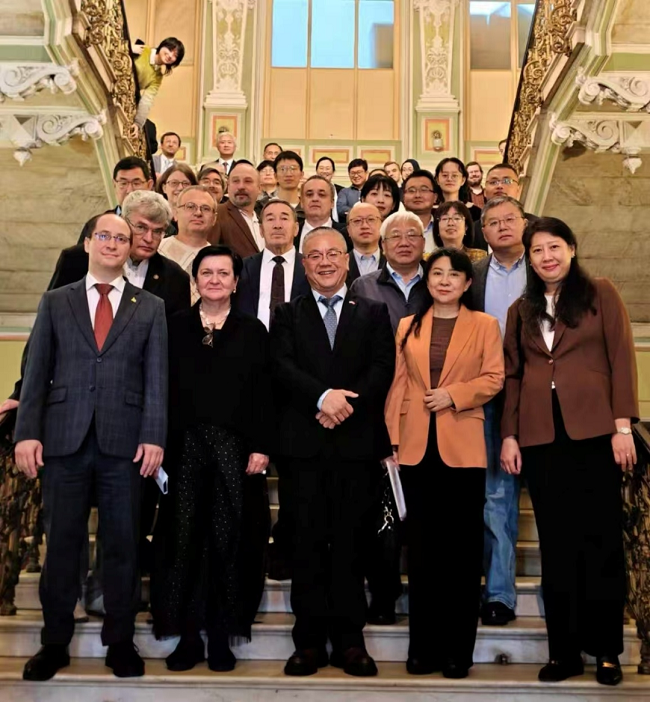
The conference opened with remarks by Academician Irina F. Popova, Director of the Institute of Oriental Manuscripts at the Russian Academy of Sciences; Mr. Ruslan G. Gagkuey, Chairman of the “History of the Fatherland” Foundation; and Mr. Luo Zhanhui, Consul General of China in St. Petersburg. The scholars in attendance then posed for a group photograph. The first session was dedicated to commemorating the centenary of the births of L. N. Menshikov and L. I. Chuguyevsky. Academician Popova delivered a presentation titled “The Research Activities of Menshikov and Chuguyevsky.” Mr. Chai Jianhong, former Vice President and Secretary-General of the Chinese Association of Dunhuang and Turfan Studies, delivered an online presentation titled “Russian Sinologist Lev Menshikov’s Contribution into the International Dunhuang Studies.” Mr. Yan Keqin of Shanghai Classics Publishing House spoke on “The Cordiality Exceeds Family Sentiments.” Mr. Fu Xianzhan of Shanghai Classics Publishing House spoke on “A Small Boat from Neva and Huangpu Rivers,” and Researcher Nie Hongyin of the Institute of Ethnology and Anthropology at the Chinese Academy of Social Sciences presented on “The Joint Work on the Edition Khara-Khoto Documents held in Russia”. The speakers reviewed the academic contributions of Menshikov and Chuguyevsky from different perspectives, with particular emphasis on the broad-mindedness and sincerity they demonstrated in collaborating with Chinese scholars and the publishers on the compilation of works including Dunhuang Manuscripts in Russian Collections and Documents from Khara-Khoto Held in Russia. These qualities remain deeply worthy of remembrance. Recalling academic exchanges between Chinese and Russian scholars more than three decades ago, Mr. Yan Keqin became choked with emotion, moving everyone present.
The formal academic sessions covered a wide range of topics. The conference featured two parallel sessions and nine panel discussions organized around six major research themes: “Contributions of Russian Scholars to Central Asian Expeditions and the Achievements of Russian Expedition Teams,” “Current Research Concerns in Dunhuang Studies,” “Current Research Concerns in Tangut Studies,” “Culture of Central Asia,” “Research on Central Asian Manuscripts,” and “Manuscripts and Artifacts from Dunhuang, Khara-Khoto and Central Asia.” A separate “Young Scholars Session” was also held, where participants presented their latest textual and historical findings and shared new research approaches, addressing key issues and challenges currently receiving attention in the academic community. On September 26, Dr. Sun Yida participated online in the session held in the Green Hall and delivered a presentation in both Chinese and English, titled “Epigraphy and Philology: Tangut Studies by Luo Zhenyu and His Sons.” The presentation examined the development of Tangut Studies in China in the early twentieth century and its significance in the history of scholarship.
During the closing session, Academician Popova spoke highly of the new progress achieved at the conference. She recognized the achievements of Chinese scholars in the areas including ancient manuscript research, the analysis of cultural relics and artworks, and the development of academic databases. She also recommended strengthening English-language academic presentations and exchanges in the future to further enhance the international communication and reach of the research. This conference effectively brought together international research expertise and provided an important platform for exchange, contributing to the further development of Dunhuang studies, Tangut Studies, and research on Central Asian manuscripts.

 打印
 收藏