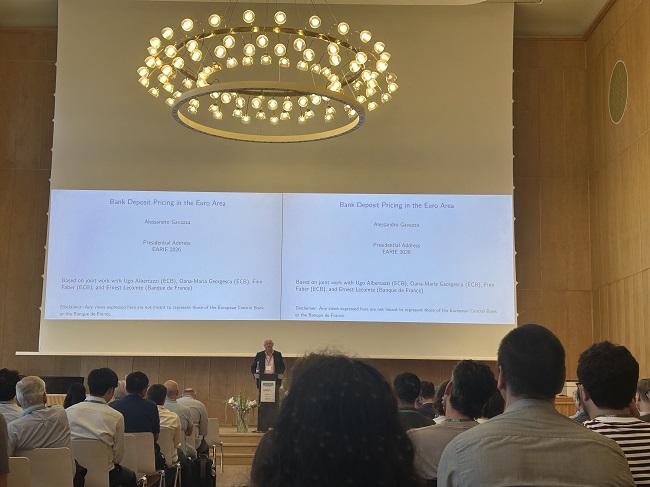
From August 26 to 28, 2026, the 53rd Annual Conference of the European Association for Research in Industrial Economics (EARIE 2026) was held in Mannheim, Germany. Organized by the European Association for Research in Industrial Economics and hosted by the University of Mannheim, the conference brought together experts and scholars in industrial economics from around the world for in-depth discussions on cutting-edge topics, including theoretical developments, research methods, and interdisciplinary applications in the field. The conference featured three keynote addresses, six invited presentations, and multiple parallel sessions.
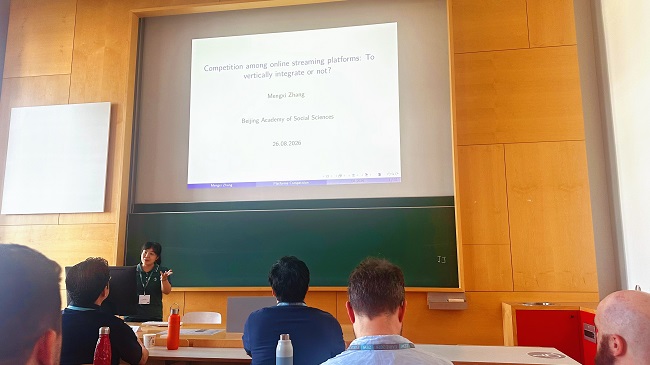
Zhang Mengxi, a postdoctoral researcher at the Institute of Management, Beijing Academy of Social Sciences, was invited to attend the conference and delivered an academic presentation titled “Competition among Online Streaming Platforms: To Vertically Integrate or Not?” at a parallel session. This study focuses on competition among online streaming platforms in China. It examines the theoretical basis for price increases resulting from cost-reduction-driven vertical mergers and acquisitions and explores changes in market competition and pricing under asymmetric competition after a single platform introduces advertising.
During the conference, Zhang Mengxi also held in-depth exchanges with Professor Jidong Zhou of Yale University, Professor Martin Peitz of the University of Mannheim, Professor Alexel Parakhonyak of the University of Oxford, Research Fellow Anja Rösner of the Rockwool Foundation in Denmark, Tomasz Sulka of Humboldt University of Berlin, and other international scholars in industrial economics. She also engaged in discussions on frontier academic issues with students and scholars from universities in China and abroad. Through the conference, Zhang Mengxi observed that international research on industrial organization in the context of the digital economy is increasingly focused on a range of frontier topics. Issues such as algorithm pricing, autonomous driving, geopolitical conflict, and the economic impact of platform regulation appeared frequently across the parallel sessions, reflecting how industrial economics is responding to the profound changes that digital technologies are bringing to market mechanisms. Looking ahead, Chinese scholars need to engage more proactively with the international academic discourse, bring China’s rich practical experience into global academic discussions, and draw on a broader range of research methods to tell China’s stories effectively. At the methodological level, structural equation modeling and truth-value simulation are being used more widely. Many presentations supplemented theoretical derivation with structural estimation or truth-value simulation tests, and the integration of theoretical models with real-world data has increasingly become a hallmark of high-level research. This research paradigm places greater demands on the academic training of researchers. Strengthening proficiency in research methods such as structural equation modeling and truth-value simulation, while improving the integration of theory and empirical analysis, is therefore an important area for future development.
The conference not only broadened the research horizons of our Academy’s young researchers, but also demonstrated our strong support for their participation in international academic exchanges. As one of the most influential annual academic conferences in the field of industrial economics, the event provided our young researchers with opportunities to present their research and received guidance and advice from internationally renowned experts. By attending keynote presentations and other sessions, they also gained valuable insights in frontier research topics and emerging methodological requirements, including structural estimation and truth-value simulation.
Our Academy’s sustained investment in and support for international academic exchanges for young researchers have built a bridge connecting young scholars with the international academic community. Such support can encourage more young researchers to advance toward the forefront of international academia through rigorous research, enhance the international academic community’s understanding of China’s practices through high-quality research outcomes, and further contribute to the Academy’s goal of becoming a nationally first-class and internationally renowned social sciences academy.

 打印
打印 收藏
收藏