
[2026 Beijing Culture Forum] Guest Presentation Review | He Yalan: Beijing’s Historical and Cultural Heritage Embraces “Continuity and Renewal” to Shape the Future Through Revitalized Transmission
 打印
 收藏
In This Issue
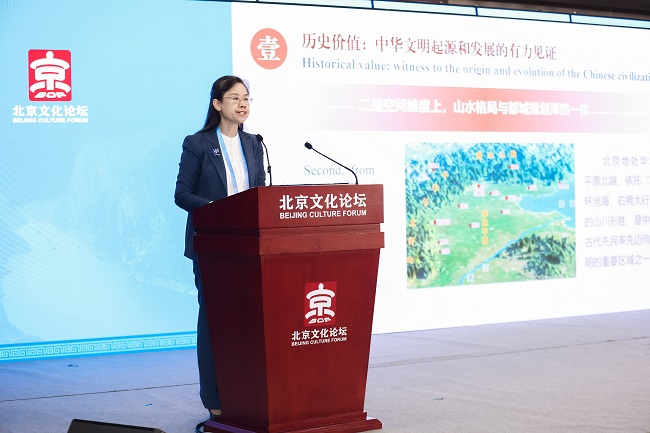
Good afternoon, everyone. I am very pleased to join you in discussing this important topic of Beijing’s historical and cultural heritage. I will address it from four perspectives.
I. Historical Value: Powerful Evidence of the Origins and Development of Chinese Civilization
II. Cultural Value: A Vivid Interpretation of Chinese Wisdom and Civilizational Characteristics
First, diversity within unity embodies an inclusive mindset. Situated at the meeting point of agrarian and nomadic cultures, Beijing has brought together different ethnic groups and regional cultures through the development of imperial capitals across dynasties and the expansion of its three cultural belts.
Second, the mutual reinforcement of rites and customs enriched everyday urban life. Material heritage and living traditions reinforce one another, ensuring that “rites” do not remain abstract concepts, but become a way of life that can be observed, experienced, and passed on.
Third, upholding fundamental principles while pursuing innovation sustains the vitality of civilization. From Guo Shoujing’s explorations in water conservancy to contemporary ecological governance, and from the Ancient Observatory to modern space programs, traditional wisdom and modern scientific and technological innovation have continued to support one another.
III. Practical Value: The Beijing Model for Conserving a Historic and Cultural City While Advancing Modernization
First, strengthening the foundations of civilization. Qianmen Street has sustained its commercial tradition for centuries; street culture remains integrated into everyday urban life, while time-honored brands complement contemporary consumption.
Second, reshaping the character of the ancient capital. The 600-year-old Longfu Temple has reopened, integrating its historical fabric with modern commercial formats and vividly embodying an urban character that is “both traditional and trendy”.
Third, unlocking new momentum for the development of cultural heritage. Beijing is using digital technologies to safeguard its heritage and has established China’s first provincial-level monitoring and early-warning platform for World Cultural Heritage sites.
IV. Value of Exchanges and Mutual Learning: Using Cultural Heritage to Build Bridges and Bonds for Dialogue Among Civilizations
First, guided by the Global Civilization Initiative, Beijing is establishing a value framework for exchanges and mutual learning among civilizations. It seeks to transcend estrangement through exchanges among civilizations, overcome clashes through mutual learning, and move beyond notions of civilizational superiority through inclusiveness, thereby promoting the harmonious coexistence of different civilizations.
Second, grounded in Chinese modernization, Beijing is articulating a Chinese approach to the governance of ancient capitals worldwide. The Beijing Central Axis, imperial gardens, and historic districts have been incorporated into a holistic conservation framework, while traditional intangible cultural heritage skills are being integrated into contemporary life and the digital economy, enabling cultural heritage to become an endogenous driver of urban development.
Third, using heritage spaces as a medium, Beijing is building practical platforms for international people-to-people and cultural exchanges. As a center for international exchanges, Beijing makes use of heritage spaces such as the Beijing Central Axis, imperial gardens, and former guild hall sites to host international cultural festivals, and exhibitions, academic dialogues, and youth exchange activities, turning historic places into venues for dialogue among different civilizations.
Embracing a spirit of “continuity and renewal,” Beijing draws strength from carrying forward its cultural heritage and shapes the future through revitalized transmission, forging a path of capital-city modernization that organically integrates tradition and modernity.