
[2026 Beijing Culture Forum] Guest Interview | Kirill Solonin: The Revitalization and Utilization of Cultural Heritage is a Concerto of Global Cooperation
 打印
 收藏
Introduction
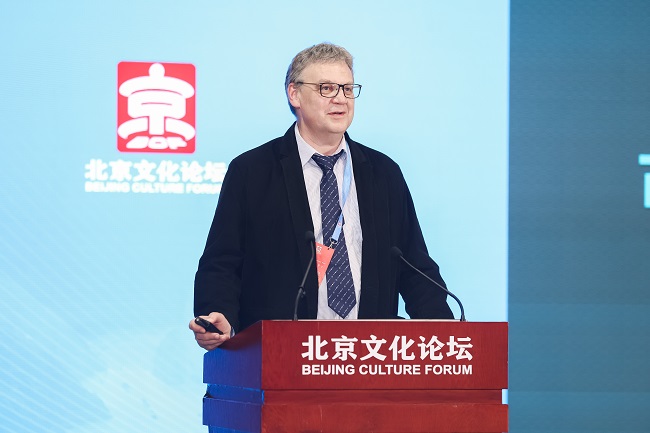
The 2026 Beijing Culture Forum was successfully held in Beijing from September 22 to 23. Guided by Xi Jinping Thought on Culture and positioned as a national-level, international and academic forum, the event brought together prominent guests from China and abroad to engage in in-depth discussion and exchange. At the specialized academic salon on “The Contemporary Value of Cultural Heritage,” hosted by the Chinese Academy of Social Sciences and organized by the Beijing Academy of Social Sciences, Professor Kirill Solonin of the Institute for Advanced Study in National Philology and Classics at Inner Mongolia University delivered a keynote address titled “Contemporary Global Narratives of Ancient Civilizational Heritage.” In an interview, he began by discussing the successive carving of the Yunju Temple Stone Scriptures by different ethnic groups, using the continuity of China’s outstanding traditional culture to explore the common origins of humanity and emphasizing the fundamental importance of this commonality for exchanges and mutual learning among civilizations worldwide.
In This Issue
A Representative Case of Multi-ethnic Interaction and Exchange: The Carving of the Yunju Temple Stone Scriptures
The Yunju Temple is a clear example of interaction and exchange among different ethnic groups. During the Sui Dynasty, a monk named Jingwan began the work, which was later continued by the Khitan people and people of the Liao dynasty. Emperor Daozong of Liao personally supported the project and provided funding. How should such heritage be preserved? Preservation does not simply mean keeping the architecture intact. It means that people continue to come and study it, learn about it, conduct research, and publish research findings. In this way, the heritage itself can be preserved.
The Shared Characteristics of Humanity and Their Significance for the Present
If we delve deeper into our research and gain a broader understanding, we will increasingly realize that many aspects of culture and much cultural heritage are, in fact, shared by humanity as a whole; they were not created by any one ethnic group alone. Whether we study archaeological discoveries or written records, we can see that no culture has developed entirely in isolation. We may not always be able to identify the specific forms of interactions because the relevant records have not been preserved. Traditional Chinese culture has developed through continuous transmission without interruption. From the “Three Sovereigns and Five Emperors” to the present, different individuals have made contributions, and various ethnic groups have engaged in exchanges in many areas.
We can also see that many aspects of our daily lives are filled with elements that constitute cultural heritage. Take something as simple as eating with chopsticks: it is a practice with a history spanning thousands of years and is a form of living cultural heritage. Viewed more broadly, language itself is perhaps the most vivid form of living culture. Human beings do indeed share a common background and origin. We all possess the ability to speak and to express meaning through sound. We communicate in sentences, with structures involving subjects, objects, and predicates. Whether one speaks Chinese, Russian, English, or Spanish, there are shared structural features. Because we possess these common capacities, we are able to learn from and communicate with one another.