
[2026 Beijing Culture Forum] Guest Interview | Lin Yufeng: In the AI Era, Telling China’s Stories Should Be Like Serving Tea—Let People Enjoy It to Their Own Taste
 打印
 收藏
Introduction
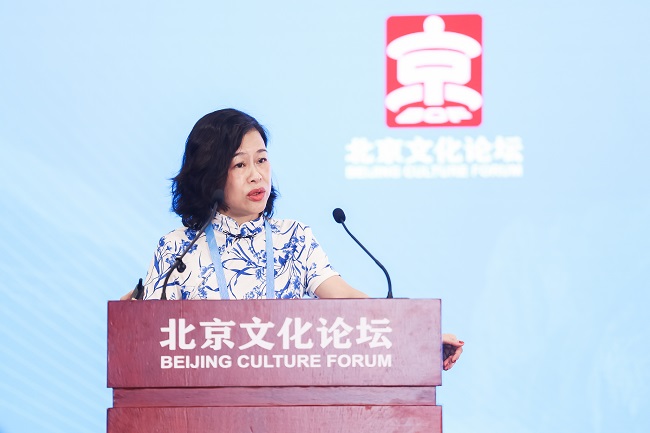
The 2026 Beijing Culture Forum was successfully held in Beijing from September 22 to 23. Guided by Xi Jinping Thought on Culture and positioned as a national-level, international and academic forum, the event brought together prominent guests from China and abroad to engage in in-depth discussion and exchange. At the specialized academic salon on “The Contemporary Value of Cultural Heritage,” hosted by the Chinese Academy of Social Sciences and organized by the Beijing Academy of Social Sciences, Lin Yufeng, Director of the Centre for Macau Studies at the University of Macau, delivered a keynote address titled “Cross-Cultural Communication in the AI Era.” In an interview, she began by discussing the ways Chinese tea culture has spread internationally and used this as a starting point to discuss narrative strategies for telling China’s stories effectively in the AI era. She noted that only through rigorous, in-depth research, and against the backdrop of a shared corpus, can mutual learning among civilizations be better promoted.
In This Issue
A Classic Example of the International Communication of Chinese Culture
Chinese tea offers a good example. As early as the mid 16th century, the Portuguese merchants and missionaries learned the word “cha” or “chá” through Cantonese in Macao, making Portuguese “chá” the only major language in Western Europe to follow the “cha” root. When Dutch merchants traded through Fujian, the Minnan pronunciation “tê” entered Europe, becoming “tea” in English and “thé” in French. Meanwhile, Along the overland Silk Road, it also evolved into “chai” across Eurasia and India. Tea, which originally came from China, has been open to adaptation for others. People prepare it according to their own tastes; the British and Indians add milk, and people in Hong Kong(China) and Macau(China) also drink milk tea. Today, many teas popular among young people in China still use a Chinese tea base, which may contain milk and other ingredients. In that sense, tea, which originated in China, has travelled around the world and come back to us in new forms. Tea culture today is therefore extremely rich. Yet this diversity does not prevent people in Chaozhou from preparing tea in the traditional Chaozhou way. Our tea traditions have not been lost. As tea has spread around the world, people have absorbed Chinese culture in their own ways and in accordance with their own lifestyles.
AI Empowers the Telling of China’s Stories Through Cultural Heritage
Today, AI has made language reproducible at virtually no cost. With AI, I hope we can approach cultural communication in the same way as tea: we provide the methods for growing the tea, and everyone can learn them, but how people choose to drink it is entirely up to them. We need to make our research better and deeper, because AI is essentially a vast corpus. An AI's output mainly reflects the distribution of its training corpus; at the corpus level, the AI itself has no position; it responds to the distribution of the materials in the corpus. Whichever direction the greater body of material tends toward, AI will tend to follow that direction. To tell China’s stories effectively, it is therefore essential that we provide sufficient source material. Putting primary materials online is the first step. By opening up our resources, we allow people around the whole world to access them at the same time. We can make the same corpus available to everyone, while recognizing each individual, every country, and each scholar may have their own unique interpretation. We should do our best to conduct our research thoroughly, publish it properly, translate it accurately, and submit our work for publication. At the same time, we should welcome others to use our materials for their own research. In this way, we can genuinely achieve mutual learning among civilizations—you within me, and I within you.