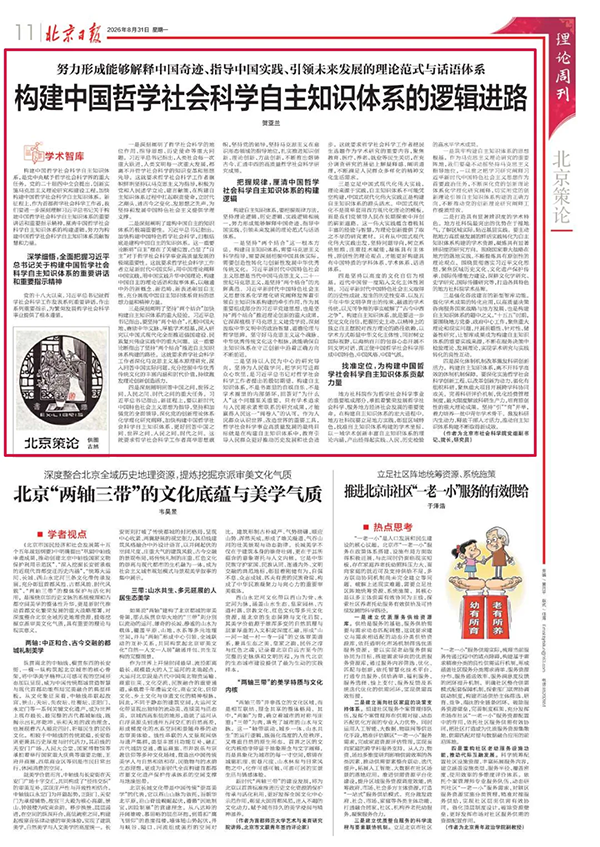
Published in Beijing Daily, August 31, 2026, Page 11.
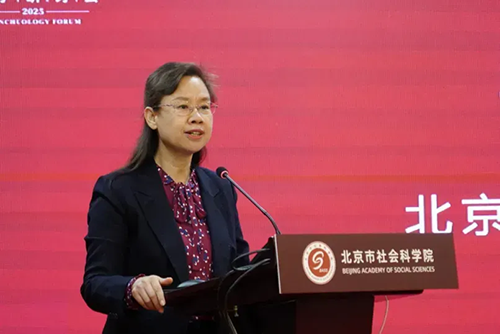
He Yalan
President and Research Fellow, Beijing Academy of Social Sciences
Building a Chinese intellectual system in philosophy and social sciences is a major task entrusted to the philosophy and social sciences community by the CPC Central Committee. The Fourth Plenary Session of the 20th CPC Central Committee called for innovative implementation of the Marxist Theory Research and Development Project and accelerated efforts to build a Chinese intellectual system in philosophy and social sciences. On this new journey, as philosophy and social sciences researchers in the capital, we must deepen our understanding of the guiding principles of General Secretary Xi Jinping’s important speeches and instructions on building a Chinese intellectual system in philosophy and social sciences, clarify the underlying logic of its development, and strive to contribute our wisdom and strength to this important endeavor.
Deepen Study and Understanding: Fully Grasp the Guiding Principles of General Secretary Xi Jinping’s Important Speeches and Instructions on Building a Chinese Intellectual System in Philosophy and Social Sciences
Since the 18th National Congress of the Communist Party of China, General Secretary Xi Jinping has delivered a series of important speeches and issued a series of important instructions on work in philosophy and social sciences, providing fundamental guidance for the advancement and development of philosophy and social sciences.
First, he has profoundly elucidated major issues such as the status and role, guiding principles, and historical mission of philosophy and social sciences. General Secretary Xi Jinping has pointed out that every major leap forward in human society and every major advancement in human civilization is inseparable from transformations in knowledge and the intellectual guidance provided by philosophy and social sciences. This requires philosophy and social sciences researchers to unequivocally uphold Marxism as their guiding principle, actively conduct scholarship and develop theory for the Party and the people, and offer policy advice and recommendations. In the process of building a Chinese intellectual system in philosophy and social sciences, they must shoulder their responsibilities and mission, stand at the forefront of the times, understand the evolution of the past and the present, and lead the way in intellectual innovation, thereby providing theoretical support for upholding and developing socialism with Chinese characteristics.
Second, he has profoundly elucidated the critical importance of building China’s independent intellectual system. General Secretary Xi Jinping has pointed out that accelerating the development of philosophy and social sciences with Chinese characteristics ultimately requires building China’s own independent intellectual system. This important assertion places “independent” at the core, highlighting its critical importance for the high-quality development of philosophy and social sciences. This requires philosophy and social sciences researchers to ground their work in the realities of China in the new era, interpret Chinese practice through Chinese theory, and enrich Chinese theory through Chinese practice. They should develop China’s independent theoretical discourse and narrative system, demonstrate intellectual independence through new concepts, categories and expressions that draw on both Chinese and international perspectives, and fully convey the intellectual and spiritual strength underpinning China’s independent intellectual system.
Third, he has profoundly elucidated the important experience of adhering to the “Two Integrations”, namely the integration of the basic tenets of Marxism with China’s specific realities and with China’s fine traditional culture, to accelerate the building of an independent intellectual system. General Secretary Xi Jinping has emphasized the need to uphold the “Two Integrations,” remain firmly rooted in China, carry forward the continuity of Chinese culture, strengthen academic foundations, and conduct in-depth research on major issues arising from the practice of advancing the building of a strong country and national rejuvenation through Chinese modernization. This important statement identifies a clear path for advancing the development of an independent intellectual system through the “Two Integrations.” This requires philosophy and the social sciences researchers to deepen their study of the basic principles of Marxism, respond more effectively to practical issues in China, fully explore the rich meaning and contemporary value of China’s outstanding traditional culture, and continuously stimulate the vitality of theoretical innovation and creativity.
Fourth, he has profoundly elucidated the major task of answering the questions posed by China, the world, the people, and the times. General Secretary Xi Jinping has pointed out that, on the new journey, we must be guided by the Thought on Socialism with Chinese Characteristics for a New Era, uphold and strengthen the Party’s overall leadership, deepen the systematic and theoretical research and interpretation of the Party’s innovative theories, accelerate the building of a China’s independent intellectual system in philosophy and social sciences, and better answer the questions posed by China, the world, the people, and the times. This requires philosophy and social sciences researchers to hold high the banner of the guiding ideology, uphold the Party’s leadership, maintain the guiding role of Marxism in the ideological sphere, steadily advance innovation in knowledge, theory, and methodology, and continuously produce high-quality research in philosophy and social sciences that draws on both past and present and brings together Chinese and international intellectual traditions.
Understand the Underlying Principles: Clarify the Logic of Building of a Chinese Intellectual System in Philosophy and Social Sciences
To build an independent intellectual system, we must understand its underlying laws and methods, uphold the unity of theoretical, historical, and practical logic, and strive to form a theoretical paradigm and discourse system capable of explaining the “Chinese miracle,” guiding Chinese practice, and leading future development.
First, we must adhere to the “Two Integrations” as a fundamental approach. Building an independent intellectual system requires the scientific guidance of Marxism, a profound understanding of China’s specific realities, and the creative transformation and innovative development of China’s outstanding traditional culture. Xi Jinping Thought on Socialism with Chinese Characteristics for a New Era is contemporary Chinese Marxism and Marxism of the 21st-century, and represents a shining example of adhering to the “Two Integrations.” Systematic and theoretical research and interpretation of Xi Jinping Thought on Socialism with Chinese Characteristics for a New Era plays a leading role in guiding the development of an independent intellectual system. Xi Jinping Thought on Party Building, as an important component of Xi Jinping Thought on Socialism with Chinese Characteristics for a New Era, is also a major achievement in advancing theoretical innovation through the “Two Integrations.” It is deeply rooted in Marxist theories of Party building and draws extensively on the political wisdom, moral thought, and philosophical reflection of Chinese civilization. By firmly upholding Marxism as the intellectual lifeline and China’s outstanding traditional culture as the cultural root, we can ensure that the independent intellectual system continues to advance in the right direction while upholding fundamental principles and breaking new ground.
Second, we must adhere to a people-centered research orientation. Conducting scholarship for the people and ensuring that academic work resonates with them is an earnest expectation that General Secretary Xi Jinping has placed on philosophy and the social sciences researchers. Building an independent intellectual system is neither an exercise in self-indulgence confined to the study nor a closed-circle within the academic community. It is therefore essential to answer the fundamental question of “for whom” academic work is undertaken. Only research that closely connects academic pursuits with the needs of the people can earn the recognition of the people, who are the ultimate “examiners” of such work. As an important means through which the people understand and transform the world, philosophy and social sciences ultimately seek, through building of an independent intellectual system, to educate and guide the people in better advancing historical development and social progress. This requires philosophy and social sciences researchers to make issues concerning people’s livelihoods as an important focus of their academic research, particularly education, healthcare, elderly care, and employment. On the basis of thorough investigation and research, they should address questions, explain underlying principles, and continuously meet the people’s diverse intellectual and cultural needs.
Third, we must ground our work in the great practice of Chinese modernization. Theory originates in practice, and an independent intellectual system cannot be built in isolation from reality. The great practice of Chinese modernization provides a continuous source of vitality for building such a system. Chinese modernization is not a simple application of Western modernization theories, but a new path pioneered by our Party in leading the people through long-term exploration. This great practice embodies a wealth of experience and wisdom and provides an inexhaustible source of research material for theoretical innovation. Only by proceeding from the great practice of Chinese modernization, maintaining a problem-oriented approach, applying systematic thinking, harnessing the enabling role of technology, and developing theoretical perspectives that demonstrate intellectual independence and originality can we better build disciplinary, academic, and discourse systems with distinctive Chinese characteristics.
Fourth, we must take a high degree of cultural confidence as a fundamental foundation. Modern China once faced a crisis of cultural subjectivity. The historic achievements and transformations of socialism with Chinese characteristics in the new era, together with the academic traditions of continuity and integration nurtured by five thousand years of Chinese civilization, have provided compelling answers to the long-standing debate over the relationship between the ancient and the modern, and between China and the West. Building an independent intellectual system requires us to further strengthen cultural confidence, seize the historic initiative, free ourselves from dependence on Western theoretical frameworks through intellectual and spiritual independence, and affirm the subjectivity of Chinese culture through academic scholarship. At the same time, we must maintain an international perspective and engage in dialogue among different civilizations with an inclusive mindset, so that philosophy and social sciences in China can truly develop distinctive Chinese characteristics, style and intellectual character.
Clarify our Role: Contribute to the Construction of a Chinese Intellectual System in Philosophy and Social Sciences
As an important part of the philosophy and social sciences community, local academies of social sciences shoulder the important mission of promoting the advancement of philosophy and social sciences and serving local economic and social development. In the broader process of building an independent intellectual system, local academies of social sciences should ground their work in local practices, highlight regional characteristics, and identify their appropriate academic position with the development of the independent intellectual system. Through academic innovation rooted in their respective regions, they can enrich the theoretical substance of the independent intellectual system and produce high-quality academic research outcomes that can stand the test of practice, the people, and history.
First, we must strengthen the ideological foundation for building an independent intellectual system. As an important center for Marxist theoretical research, we must unwaveringly uphold the guiding role of Marxism and consistently regard the study, research, and interpretation of Xi Jinping Thought on Socialism with Chinese Characteristics for a New Era as our foremost political task. We must continue to deepen systematic and theoretical research and interpretation of the Party’s innovative theories, ensure that these theories guide the development of the independent intellectual system in the right direction, and continuously improve the quality and effectiveness of research and interpretation of the Party’s innovative theories.
Second, we must develop distinctive academic strengths with a clear identity. One of the greatest strengths of local academies of social sciences is their close connection with local realities and grassroots practices. We should proactively transform the dynamic practices of high-quality local development into academic resources for building an independent intellectual system and develop clearly differentiated research areas. By focusing on the local implementation of major national strategies, we should continue to develop original theoretical perspectives. In implementing Xi Jinping Thought on Culture, we should focus on regional history and culture, the protection and inheritance of cultural heritage, and the development of international communication capabilities. We should deepen research in cultural studies, history, and international communication, and build distinctive academic brands for local academies of social sciences.
Third, we must strengthen the policy advisory role of new-type think tanks. We should enhance the translation and application of academic research to provide high-quality policy consultation in support of national strategies and local development. This is also an integral part of building an independent intellectual system. During the 15th Five-Year Plan period, we should focus on the key priorities of local Party committees and governments, address major theoretical and practical issues, and conduct forward-looking, targeted, and preparatory research. The think tank research should serve as an important practical source for building an independent intellectual system, enabling theory to be tested and further developed through decision-making support and fostering a mutually reinforcing relationship between academic research and its practical application.
Fourth, we must deepen institutional and systemic reform to stimulate vitality in research and innovation. Building an independent intellectual system requires the support of sound and efficient institutions and mechanisms. We should further advance the Philosophy and Social Sciences Innovation Project, use reform and innovation as driving forces, strengthen organized research, and promote interdisciplinary collaboration on major projects. We should improve research evaluation mechanisms, optimize funding management systems, fully unleash research productivity, and foster major original theoretical achievements. We should place equal emphasis on attracting and cultivating talent and focus on developing a strong cohort of young and mid-career academic leaders. By stimulating the endogenous momentum of scientific research and unleashing the vitality of researchers and personnel, we can continue to achieve new progress in building an independent intellectual system.
Source: Beijing Daily

 打印
打印 收藏
收藏