Wang Shaozhong noted that China’s participation in the Memory of the World Programme has evolved from a process of learning from international experience to one of active engagement. At present, a three-tiered register system has been established under the Programme, comprising the National Register, the Asia Pacific Regional register, and the International Register. Concern for, support for, and participation in the preservation of archival and documentary heritage has become a broad social consensus. China will place priority on strengthening public awareness of the Memory of the World Programme, standardizing the nomination and management of China’s documentary heritage registers, enhancing the protection, inheritance and revitalized utilization of archival and documentary heritage, and accelerating digital transformation and intelligent upgrading to bring dormant documentary heritage “back to life.”
Zhao Lei noted that as China’s capital and national cultural center, Beijing is an important repository and major showcase for China’s outstanding traditional culture. The city has long upheld the principle of cultural diversity and placed great emphasis on strengthening the protection and transmission of archival and documentary heritage, and actively participated in the exchanges and cooperation related to the Memory of the World. Looking ahead, Beijing will focus on improving its historical and cultural heritage protection system, promoting the revitalization and utilization of heritage, enriching diversified forms of communication, and deepening international exchanges and cooperation, so that cultural heritage may shine through mutual learning and exchange.
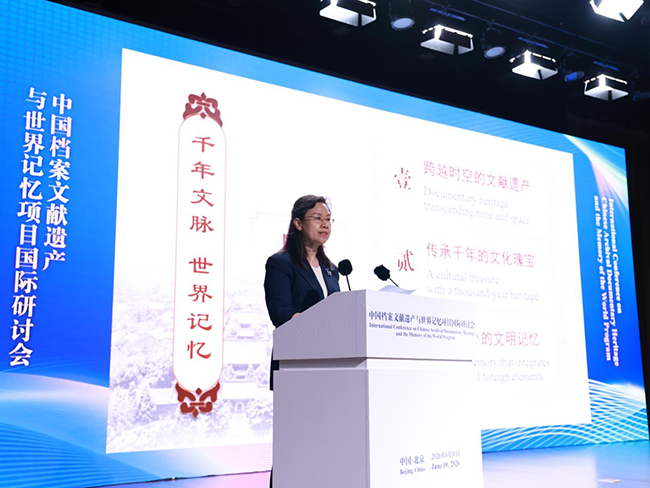
During the keynote speech session, He Yalan, President of the Beijing Academy of Social Sciences and Head of the Expert Group of Yunju Temple Historical Documents Research Base, delivered a presentation titled “Millennial Cultural Continuity, Memory of the World: The Unique Value and Civilizational Significance of the Yunju Temple Sutra Collection”. She systematically explained the unique value of the Yunju Temple Sutra Collection from three perspectives: documentary heritage, cultural transmission, and mutual learning among civilizations.
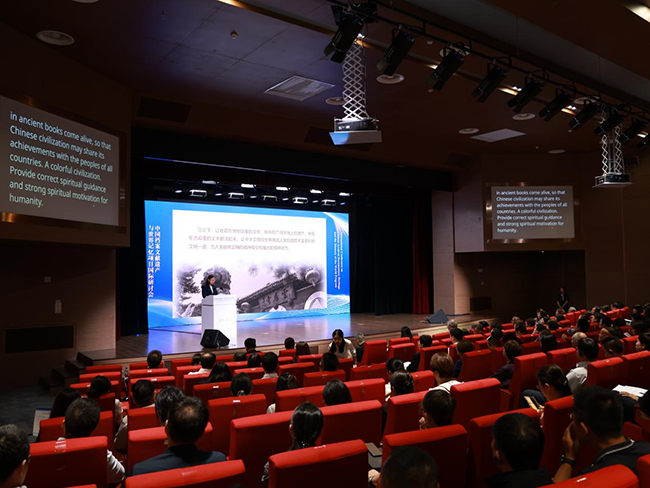
He Yalan pointed out that the Yunju Temple Sutra Collection, which began to be engraved in the Sui Dynasty and has continued down to the present day, has remained unchanged in content and has been completely preserved. It is not only the national foundational repository of original ancient Chinese-language Buddhist texts but also as a complete body of material evidence for studying the evolution of ancient Chinese Buddhism, social beliefs, ethnic integration, and cultural inheritance. The stone scriptures in the Yunju Temple perfectly integrate Buddhist scriptures with the art of stone carving. The Buddhist figures on the Thousand Buddha Pillars in the Leiyin Cave complement the engraved scriptural texts, together forming an artistic masterpiece that unites architecture, sculpture, and calligraphy. The Ming Dynasty paper sutras and the Qing Dynasty woodblocks of the Longzang (Qianlong Tripitaka), likewise fully demonstrate the exceptionally high standards of ancient Chinese calligraphy, woodblock printing, and bookbinding arts. The very process of carving and preserving the Yunju Temple Sutra Collection is, in itself, a cultural endeavor that connects regions and transcends national borders. The Yunju Temple Sutra Collection is not only a significant embodiment of Chinese civilization but also an integral part of the knowledge system of Buddhist civilization in East Asia and the world.
He Yalan stated that, going forward, it is important to actively respond to the Global Civilization Initiative, work together with Chinese and international experts and scholars, and systematically interpret the textual connotations and cultural genes of the Sutra Collection from an interdisciplinary perspective, so as to contribute social science expertise to the protection, utilization, and transmission of the historical and cultural heritage of the Yunju Temple Sutra Collection. In this way, this treasure of civilization may truly endure on the shared stage of humanity and continue to benefit future generations.

 打印
打印 收藏
收藏